Building the AI Infrastructure for Medication Access with Sahir Jaggi
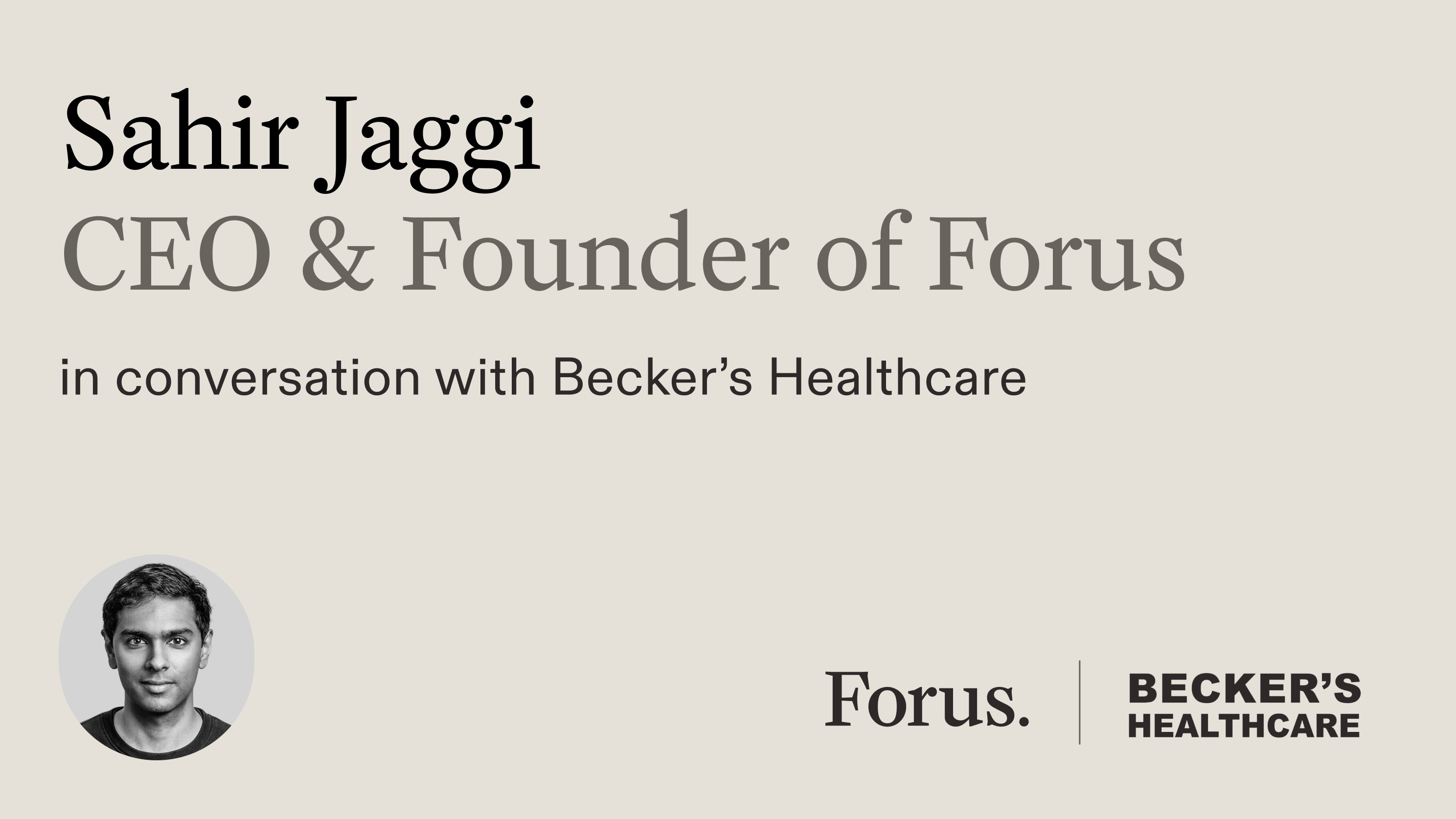
In this Becker's Healthcare Podcast episode, Sahir Jaggi (CEO) discusses how Forus is using AI to automate prior authorizations, appeals, and medication access workflows, helping providers and patients navigate one of healthcare’s most complex challenges.
Listen to the podcast on Spotify or Apple Music!
This transcript has been edited for clarity and length.
Scott Becker: This is Scott Becker with the Becker’s Healthcare Podcast. I’m thrilled to be joined by an incredible entrepreneur, Sahir Jaggi, founder and CEO of Forus. The company recently went through a rebrand, and he’ll tell us about Forus, what the company is doing, and how it has grown so much.
Someone brilliant introduced me to Sahir, and after having a chance to visit with him, I can say he’s one of the smartest young entrepreneurs I know—although maybe not that young; he just looks young.
Sahir, tell us about the founding of Forus, what you’re doing, and a little about your background.
Sahir Jaggi: Thanks so much for having me, Scott. I really appreciate it, and I’m excited to be here.
As you mentioned, I started Forus a few years ago. Forus is a platform for automating access to medication. We’re building the layer that accelerates medicine for the people who need it, prescribe it, and create it.
We started the company about three years ago and have spent that time supporting providers and patients across the country. We help people get access to medicine faster, more easily, and more affordably by automating all the complexity that normally falls on their shoulders.
When a doctor prescribes a medication today, there’s often a long, manual process before the patient can actually get it: the prior authorization, the documentation the health plan wants, the appeal when a request is denied, and figuring out how the patient can afford it.
The AMA most recently found that physicians and their staff spend 13 or 14 hours a week on prior authorizations and handle nearly 40 authorizations per provider per week in their clinics. Nearly four in five providers say patients end up abandoning treatment because of that process.
It falls hardest on people with the most serious and expensive conditions—autoimmune diseases, metabolic disorders, and cancers. The drugs are expensive and unaffordable without insurance coverage or financial assistance, and they often involve complicated supply chains. Our platform is the automation layer for all of that.
Our AI facilitates every step in the process, from identifying a patient’s insurance coverage and benefits to generating prior authorizations and appeals, coordinating the back-and-forth among health plans, pharmacy benefit managers, and pharmacies, and even working through the affordability and financial-assistance options available to patients.
Work that used to keep someone in the office on the phone all day can now be handled automatically.
Best of all, we’ve been able to build it in a way that’s free for providers and patients. A lot of the best tools providers rely on today tend to be free for them, and I don’t think that’s a coincidence.
Providers are stretched far too thin to pay for the infrastructure they depend on. The cost of these broadly used platforms increasingly belongs with larger players in the system that have the margin to carry it—payers, life sciences companies, and even the government—rather than the people on the front line.
We’ve been working on this for a few years and, as you mentioned, just had a big public launch following our funding.
“Work that used to keep someone in the office on the phone all day can now be handled automatically.”
Scott Becker: Congratulations. Let’s talk about your background. You’re a Columbia University graduate and spent years developing strategy at Oscar Health. How did you make the transition to this area and decide to found and lead the company?
Sahir Jaggi: I joined Oscar Health in 2017, when the company was trying to scale significantly. That gave me a front-row seat to the full spectrum of problems in the healthcare system.
I worked most prominently on the patient and consumer experience and spent a lot of time thinking about the different ways we could make people’s lives easier in such a complicated system.
I got exposure to problems across everything from how challenging it is to choose and buy an insurance plan, to understanding your benefits, to figuring out what happens after someone prescribes a medication or orders a test. How do you know where you can go? What’s in network? Even figuring out what people need to do when they have an emergency can be difficult. There’s a wide variety of problems.
What I learned at Oscar was that, as a single player in the ecosystem, you can solve some of the problems for some of the people some of the time. But it’s really challenging to provide a solution that is universal or durable for any individual provider or patient, because throughout their lives they’re going to move through different insurance plans, providers, and treatments.
While I was there, we started to see the advent of new technology, AI, and large language models, which you and many of the listeners are familiar with. Luckily for me, a number of Oscar’s main investors were also deeply involved in the companies behind this technology.
That started me thinking: Is there an opportunity to build something that can work for everyone all the time, rather than only for a slice of people some of the time?
AI models are really good at a couple of things that provide the capability to do more. First, they can digest a tremendous amount of heterogeneous information and treat it all the same. Second, they can brute-force their way through difficult processes that are hard to scale with people.
That gives you an opportunity to build what I think of as an abstraction or advocacy layer on top of the system—helping people navigate it without having to understand all the complexity underneath.
After spending five or six years at Oscar learning the ropes of both the healthcare system and how to build a fast-growing company, I made the leap to start Forus, working with many of the same investors and some of the same team, but focused on this problem.
Scott Becker: Remarkable. You’ve been at it for about three years now. Give us a sense of how it’s going. Who is your ideal customer? Who do you work with, and how do you approach the market and distribution?
Sahir Jaggi: What I’m most excited about is that, for the past few years, we’ve been able to grow with providers and patients almost entirely through word of mouth.
We’ve grown tenfold year over year for two years running. We’re now used by thousands of medical practices and health systems across all 50 states, from solo private practices to academic health systems.
We now serve patients in about 80% of residential ZIP codes in the United States. We’re providing a product that solves a key issue for physicians and patients: helping people get their medicine. It’s not only a complicated problem, but a recurring one.
If you’re prescribed a medication, you’re usually taking it every day, every week, or every month for the rest of your life with a chronic condition. At the same time, a huge portion of what many providers and specialists do is focused on medications, prescriptions, and infusions—making sure people get the treatments that can be most effective for their conditions.
Early on, we worked with physicians and providers who were family friends, friends of friends, or people we knew through our network. That helped us get the ball rolling. Very quickly, word started to spread through dinners, friends, people switching jobs, and Facebook groups.
We began to see exponential growth in inbound interest from physician groups and health systems looking for ways to solve problems that they and their staff simply don’t have the capacity to address themselves. They’re hungry for AI solutions that can solve the problem.
Scott Becker: As we move into the second half of 2026, what are you most focused on and excited about for the rest of the year?
Sahir Jaggi: What I’m most excited about is how much more AI can take on now than it could even a year ago. We’re moving beyond AI that helps you do a task faster to AI that truly owns an entire workflow from end to end.
The difference between a team feeling a little less buried and a team not having to think about a problem at all because it has been lifted from their shoulders is tremendous.
It affects not only the team directly, but also the patients they serve, because team members can devote their full attention to the problems that truly need it.
Because the models keep improving, the set of things you can automate gets bigger and better almost every month. That has kept me up at night—in a good way. We’re now focused on turning that depth into more and more impact in the settings we serve most.
At the health system level, for example, we’re moving beyond the core work of automating prior authorization, access processes, and routing within the system to more bespoke and specific tasks that require additional complexity.
Think about carrying a patient’s therapy across the inpatient-to-outpatient transition so that someone discharged with a new medication doesn’t fall through the cracks on access or cost.
In specialties such as oncology, it means ensuring that all the paperwork, authorizations, and financial assistance are handled at the right time before treatment, and navigating scheduling so a patient isn’t sitting in the chair waiting on paperwork.
We’re thinking about the through line: How can you take a platform that already has a tremendous amount of AI automation capability and mold it to each individual setting, continually making it more impactful for each type of provider or partner you serve?
That’s an exciting possibility because of how much more capable these agentic systems are today.
“We’re moving beyond AI that helps you do a task faster to AI that truly owns an entire workflow from end to end.”
Scott Becker: Fascinating. You’ve done an incredible job, from your work at Oscar Health to founding this company and understanding the levels of scale.
What advice would you give emerging founders and entrepreneurs based on the lessons you’ve learned so far?
Sahir Jaggi: Now is probably the most exciting time to be building a company and supporting people who are looking for ways to have AI transform their organizations, their work, and their lives. My advice centers on two things.
First, be ambitious about what you’re asking from your product. There’s often an instinct to be conservative in your approach: start small, pick off something you can solve for people, and grow from there. I think that’s right.
But you also want to make sure that the long-term goal you’re working toward—and what you’re able to share with your partners—can take entire categories of work and manual processes off your customers’ plates, not merely help them do something faster.
Aim higher than efficiency and work toward transforming how people operate. That’s what will be most impactful and durable as technology continues to advance.
Second, choose partners who want to work with you to adapt their settings and help you develop your product. The product you build is the culmination of your internal efforts and the ways your early partners and customers help define what you’re building.
A lot of the best technology today molds itself to the specific workflows of customers, rather than forcing a template into every setting.
The more partnership you have with your early clients and customers—helping you learn those lessons and build flexibility into your product—the more quickly you’ll be able to grow beyond them.
Scott Becker: I love what you said about thinking big and ambitiously, because so many of us get stuck in incremental approaches.
The challenge is that many people can compete with an incremental approach, and it’s hard to build something significant that people truly need if you think small. Yet many of us get stuck in that rut or view of the world.
How do you train yourself to think big? Is that part of your Oscar Health background? Does it come naturally to you? How did you develop that kind of thinking when so many of us get bogged down in incrementalism?
Sahir Jaggi: I have to give credit to a couple of places. Oscar is certainly one of them, because the original idea was so broad. Rather than building a specific workflow or tool, the idea was: Why don’t we rethink what an insurance company looks like and build it from the ground up?
There’s a lot of complexity in that, but it was a great education in how big you can think and how little you need to be tied to what seem like hard rules. In reality, when you think about things from first principles, there are many more ways to solve every problem than are obvious.
At the same time, it was a great lesson in where you need to appreciate and respect the systems that exist today and how different organizations operate.
The thing that has helped me become more practical while remaining ambitious is grounding the work in the problems of specific partners.
We want to advance the practice of medicine so every patient gets the medicine that’s best and most appropriate for them, and science is the only limit to the treatment they receive. That’s our broad, ambitious goal.
To make it real, rather than focus on it in an aggregate, nonspecific way, we think about the specific partners, practices, and systems we work with.
While keeping the big picture in mind, we understand all the nitty-gritty of how they operate and ask: What’s a plausible roadmap from where we are to that big picture?
We work with our partners and our internal team to maintain a shared long-term vision while taking a pragmatic view along the way. A lot of that comes from having an ethos and a thesis about what we think the world should look like.
One of the great things I gained from my time at Oscar and from working within the system’s complexities was becoming, in a sense, radicalized by how challenging things are for patients and providers today.
It would be a disservice to ourselves, our customers, and the industry to aim for anything less than what we believe is right for patients.
"We want to advance the practice of medicine so every patient gets the medicine that’s best and most appropriate for them, and science is the only limit to the treatment they receive. It would be a disservice to ourselves, our customers, and the industry to aim for anything less than what we believe is right for patients."
Scott Becker: I think that’s a great mix of perspectives: thinking very big, but also getting into the weeds and thinking practically about how you make a difference in the specific areas where the people you work with need it.
Sahir, thank you for joining us today on the Becker’s Healthcare Podcast. I look forward to speaking with you again and watching the growth of Forus. We really appreciate your time.
Sahir Jaggi: Thanks, Scott. I really appreciate you having me on, and I’m excited to spend more time together.