Lessons on Building the AI Infrastructure for Medication Access
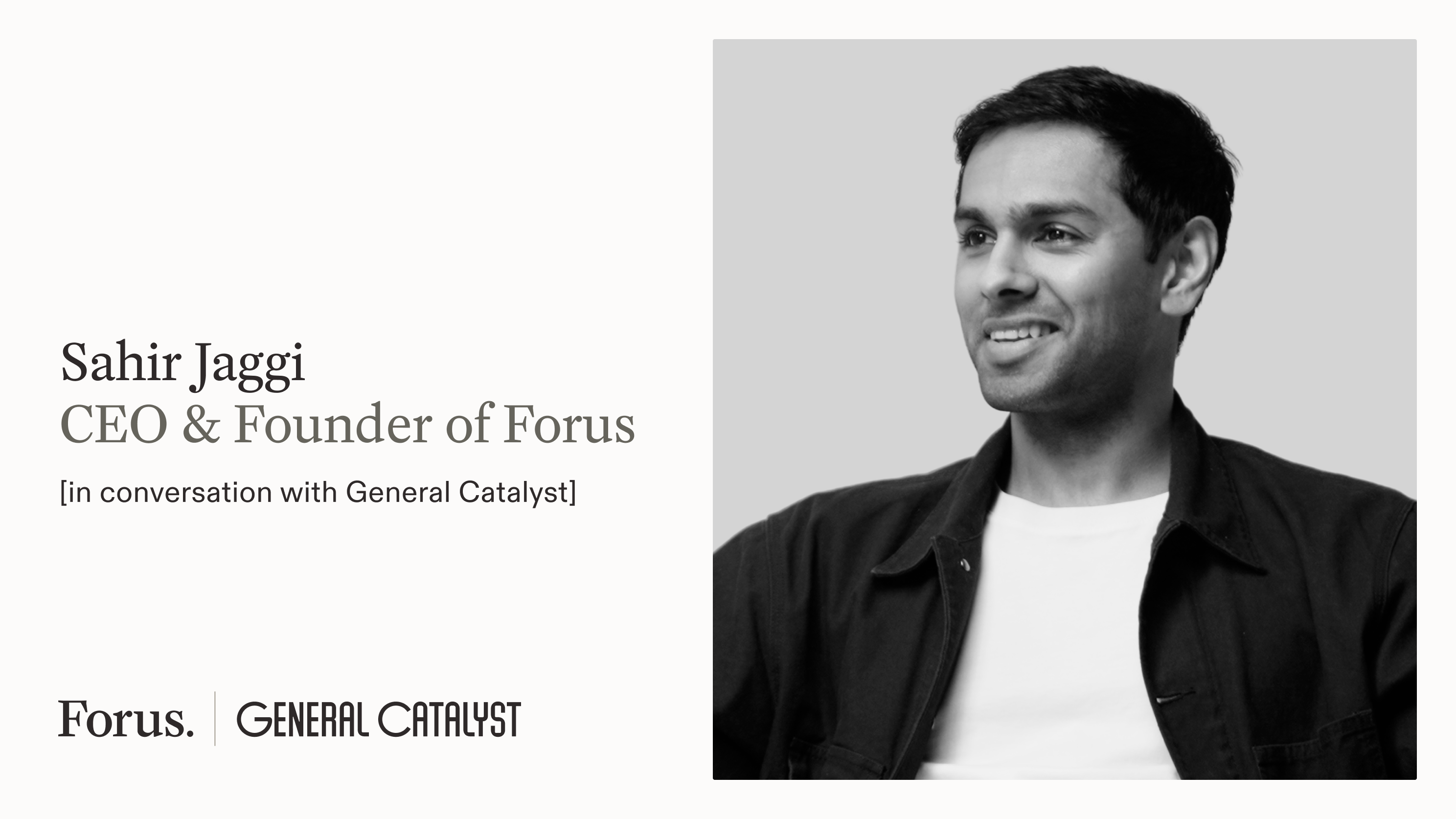
Sahir Jaggi, founder and CEO of Forus, joins Pear Healthcare Playbook hosts Anson Zhou and Andrew Parambath to discuss medication access, AI infrastructure, and building a durable healthcare company.
Read Pear’s article here, and listen to the podcast on Spotify!
This transcript has been edited for clarity and length.
From Oscar to Forus
Host: You spent five years at Oscar Health, including through its IPO. What did you learn there that has informed how you are building Forus?
Sahir Jaggi: Oscar was building a health insurer from scratch and trying to create a superior consumer experience. It was a great crash course in how healthcare works across the country: how people select insurance, how the ACA, Medicaid, Medicare, and employer markets operate, and how insurers, PBMs, providers, and health systems fit together.
One lasting lesson was what a single organization cannot solve. You can solve some problems for some people some of the time, but it is hard to provide a universal, durable solution. Over a lifetime, people move among plans, providers, geographies, and clinical circumstances. It is very hard for one player in the system to support them through all of that.
That insight is a big reason Forus exists. We wanted to create a connective layer that could sit across the system rather than operate as another individual player within it.
The bigger thing I took from Oscar was cultural. The work felt larger than the company. Every decision was treated as a choice about how healthcare in this country should work in the future. That gave people a real sense of moral imperative and created tighter bonds between colleagues. I want to bring that same energy to Forus.
Why the company became Forus
Host: The company was previously called Tandem and recently announced a $125 million Series B, bringing total funding to more than $160 million. Why change the name?
Sahir Jaggi: Tandem was the right name for our starting point. It reflected working alongside the other players in the system, which remains important to us. But as we prepared for a broader public launch, our vision for what the company stands for had become broader. We wanted a name that represented the community we serve and the seriousness of the work that sits between people and the medicine they need.
Forus captures a simple thesis in one word: medicine should work for all of us. It is a name we can grow into as we serve providers, patients, and partners nationwide.
The missing layer between prescription and treatment
Host: At first, medication access sounds straightforward: a doctor prescribes a medication, and a patient gets it. What makes that so complex in practice?
Sahir Jaggi: Many people have only experienced a prescription sent to a local pharmacy and picked up for a few dollars. For high-cost or complex conditions, the experience is very different. Think about autoimmune diseases, COPD, cancer, and other conditions where medicines are unaffordable without insurance coverage or financial assistance, have complicated supply chains, and require many phone calls and paperwork on the shoulders of doctors and patients.
The system was built for an earlier era of medicine, when there were far fewer high-cost, complex therapies. Scientific discovery has accelerated dramatically, but the connective layer between a new medicine and the patient receiving it has barely moved.
A specialty prescription can mean weeks of process and hours of labor before a patient receives a medicine already approved for their condition. Sometimes they never receive it. Physicians and staff spend roughly 10 to 15 hours per week on prior authorization and handle close to 40 requests per provider per week. Nearly 80% of providers report that patients abandon treatment because of the process.
Patients are giving up and doctors are burning out. Not because anyone wants that outcome, but because the infrastructure has not kept up. We believe recent AI advances can take on that complexity and remove the burden from providers and patients.
Prior authorization is one step, not the product
Host: Prior authorization is a crowded category. What is Forus’ distinct approach?
Sahir Jaggi: We never treated prior authorization as the core product. It is one step in a much longer path. A provider’s job is to diagnose a patient, select a treatment, get that patient onto treatment, and monitor the result. Our focus is on making it easy to execute the provider’s clinical decision.
The experience should be the same whether a physician prescribes a low-cost generic antibiotic or a new, high-cost specialty medication. The provider should not need to manage all the complexity under the hood, and the patient should receive medicine conveniently, affordably, and without unnecessary delay.
Prior authorization is one of the most visible and burdensome parts of that process, so it has drawn a great deal of noise and attention. But most companies have addressed only one slice. Forus is designed to take the prescription from the clinical decision through to the patient receiving therapy. That may mean navigating coverage, finding a lower-cost option, enrolling a patient in financial assistance, routing to the right pharmacy, or completing an authorization. We aim to find the best appropriate path for the patient.
Why the platform is free for providers and patients
Host: Forus is free for providers and patients. Why make that decision, and how does the model work?
Sahir Jaggi: The platform has been free to physicians and patients from day one. Providers are already stretched too thin, both financially and operationally, to pay for every piece of infrastructure they need – especially infrastructure required because of the complexity created by other parts of the system.
Our view is that the cost of broadly useful access infrastructure should sit with the larger organizations that have the margin to carry it: life sciences companies, payers, and, in some cases, government. The platform gives providers time back and gives patients access, while allowing us to work with industry partners to improve the broader system.
We put guardrails around those partnerships so that the product remains valuable and trustworthy for providers. For example, working with life sciences companies can make their support programs more accessible and improve the ecosystem’s understanding of where patients become stuck, to help direct resources toward solving real access problems.
Earning trust one clinic at a time
Host: What did your first customers look like, and how did the company grow from there?
Sahir Jaggi: At the beginning, there were only a few of us, the technology was early, and we needed to learn how the process really worked. We partnered with any providers willing to give us a chance – friends of friends, family connections, and clinics we found through cold outreach in New York.
We were fortunate to work with a handful of clinics across specialties, including a telemedicine-forward practice. That gave us exposure to a broad set of clinical, geographic, and payer situations quickly. It helped us stress-test the system against the full range of variation we would need to handle nationally.
Healthcare is a tight, referral-driven world. When the product works for one practice, the next practice hears about it, whether at a dinner, in a Facebook group, through staff who work at multiple practices, or from patients. We grew first geographically and then nationwide without a large sales team or a door-to-door motion.
Today, we work with organizations ranging from solo practices to large physician groups with hundreds of providers. Each early partner took a bet on us, exposed gaps in the product, and helped us build something that could serve the next provider.
Building the network in the right order
Host: Medication access touches providers, patients, pharmacies, payers, life sciences companies, and more. How did you decide where to focus first?
Sahir Jaggi: We knew it would be too difficult to build for everyone at once. For our first two full years in market, we focused almost entirely on providers and their patients. We wanted to create a product that practices of all sizes would value, that fit into their workflows, was easy to adopt, and could grow organically.
That focus gave us time to develop both the product and trust in the provider community. Once the platform had traction, other organizations – life sciences companies, pharmacies, payers, GPOs – started reaching out. Many of those relationships are partnerships rather than conventional commercial arrangements. The shared goal is to make the experience faster and easier for patients and physicians.
Provider adoption became our strongest credibility signal: partners could see that the product was working and scaling in the community, creating large opportunities for win-win partnership.
Host: Was there a particular moment when you knew you were ready to work with those other partners?
Sahir Jaggi: In many cases, they came to us before we had fully planned for it. Early conversations had not always clicked because we were still finding our footing. Then people began writing to us through the same website and provider-support channels that practices used, saying they had heard about us from a physician and wanted to explore working together.
Those early partners became design partners. Together, we learned how to create relationships that benefit them, us, providers, and patients – and then how to turn that work into something repeatable.
Bottom-up distribution with GPOs
Host: MedicoCX, a nationwide GPO serving more than 300 independent practices, is a notable example. How did that relationship happen?
Sahir Jaggi: GPOs, MSOs, and other aggregators help practices scale and access capabilities they might not have on their own. Our relationships with them have often developed bottom-up. One or two practices in a group discover Forus, begin using it, and word travels through the organization. Eventually, the GPO reaches out and asks whether the platform could become a standard part of its offering.
MedicoCX is a good example. It supports more than 300 independent practices, primarily in allergy, and runs some operations for a growing number of offices. Its centralized team was spending roughly two-thirds of each day on the phone with payers and pharmacies for complex medications. The pain is sometimes held at the clinic level and sometimes centralized in a parent organization.
Many groups like MedicoCX have spent years assessing automation or outsourced-service options. The tools often fell short because they were limited to certain medications or only worked when the company controlled dispensing. Forus is neutral: the automation works across users and fulfillment paths. By the time a larger organization contacts us, it may already have seen results from member practices, effectively giving it a live pilot and the confidence to scale.
Turning complexity into a network advantage
Host: How does serving more medications, specialties, and patients make the product better?
Sahir Jaggi: Unlike many AI work tools, our product changes dramatically by user. Specialty, medication cost, local geography, payer dynamics, regulations, pharmacy requirements, and manufacturer rules all vary. The heterogeneity expands exponentially as we grow, and the rules are constantly changing.
That is difficult, but it is also the source of the network advantage. Every transaction teaches the system something. The next practice confronting the same payer and benefit design can benefit from what we learned before. As the knowledge compounds, we can predict what will happen in cases we have not yet seen, identify where change may be coming, and prioritize integrations and partnerships that make the product more reliable.
We are gradually turning a black-box ecosystem into a glass box: one in which we either know what is happening or can predict it with high confidence. The same complexity that makes medication access painful for an individual practice is what makes a network increasingly valuable once it can manage that complexity.
Clinical intelligence and quality
Host: How do you stay current as payer, drug, state, and specialty rules change?
Sahir Jaggi: We benefit from the rapid improvement of frontier models, but the hard work is translating that technology into a healthcare workflow with changing rules and real clinical nuance. We have built an in-house clinical intelligence platform and team rather than relying solely on outside consultants.
The team is led by Dr. Adam Harris, who was previously VP of Applied AI at Oscar and is also an attending physician at NYU and Bellevue. Alongside other clinicians who understand both the specialties we serve and the practical work of prior authorization, the team sits across the product lifecycle. They work directly with our machine learning teams to ensure the automation reflects how clinics operate while staying aligned with payer rules and specialty-specific nuance.
Real-world signal and clinical expertise reinforce each other. The team learns from prescription volume, spots patterns and payer changes, and turns an edge case in one practice into a platform-wide improvement.
Host: What metrics tell you the product is improving?
Sahir Jaggi: Because the platform is free, we are wholly dependent on the quality of the experience. There are no contracts or sunk costs holding users in place. If we stop providing utility, they can stop using us.
We care about time to therapy, time spent on data entry and phone calls, approval rates, and access rates. The biggest effects we see for practices are speed for patients and lower overhead for teams. We are not changing a payer’s ultimate decision; we are making sure the process is followed accurately and completely: submitting to the right place, supplying the right evidence, catching follow-ups, and carrying the work through to resolution.
Working with the existing healthcare stack
Host: How does Forus relate to incumbents such as CoverMyMeds and Epic?
Sahir Jaggi: We generally integrate rather than collide. Companies such as CoverMyMeds have built important clearinghouse infrastructure for electronic prior authorization and benefit verification. We build on top of that infrastructure, adding the end-to-end automation that carries a prescription from the provider’s decision to a ready-to-fill medication.
Likewise, we work alongside EHRs such as Epic rather than trying to replace them. EHRs are designed around the physician office and direct interaction with patients. Much of our work occurs after the clinical decision, outside the clinic: initiating and handling the access process, then bringing information back and closing the loop.
We are usually not replacing an existing product. We are filling a gap where staff time, rather than software, historically handled the work. AI can now manage a level of complexity that traditional software could not.
Advice for AI and healthcare founders
Host: What advice would you offer founders building in healthcare today?
Sahir Jaggi: Be ambitious about what you ask of your product. It is right to start with a focused wedge, but a feature or incremental efficiency gain can be short-lived in a market where technology is moving quickly. Have a long-term view of the entire category of work you want to take on for customers. Aim beyond efficiency toward transforming how they operate.
The most durable companies will own full categories and become synonymous with how those categories are managed. To make that real, work with partners who share that ambition and are willing to help adapt the product to their setting. Early partners teach you how to build flexibility and how to keep expanding toward the bigger picture.
When choosing teammates and investors, I look for problem-solving ability, resourcefulness, and intellectual honesty. Teams need people who can absorb complexity, generate multiple paths forward, and find a way to solve a six-month problem in six weeks. We also have a value we call “spit it out”: people should say when something is not working, give and receive direct feedback, and avoid becoming attached to their own ideas.
On building in stealth
Host: Forus spent about three years in pseudo-stealth. Would you recommend that approach to other founders?
Sahir Jaggi: It was right for us, but it is not right for everyone. Building under the radar let us focus on the product and the user experience, develop a real head start in the provider network, and avoid attaching a public story or brand to the company before we had fully understood what we were building.
We wanted to announce only when it would create value we could not achieve otherwise. Once we were ready to bring the platform to every doctor’s office and recruit more talent around the mission, being public became important.
The trade-off is that stealth can slow you down if you depend on awareness to attract customers or talent. We were fortunate to have strong word of mouth with both providers and prospective teammates. The timing decision can be difficult, however, and I still wonder whether we should have announced a few months earlier. Now, we want everyone in the country to know who we are and what we are building.
Host: Thank you for joining us and for sharing how Forus is improving access for providers and patients.
Sahir Jaggi: Thank you. Pear has been an investor from the beginning, and we are grateful for the partnership. We are excited to keep building.